In September 2026, a five-to-seven-page website for a UK small business costs £1,000 to £5,000 from a solo or small studio, £300 to £2,000 from a freelancer, and £8,000 to £15,000 from an agency. Build it yourself on Squarespace or Wix and it costs £9 to £29 a month plus 20 to 60 hours you will not get back. A single landing page with a lead magnet is £500 to £1,500. A small shop starts around £3,000 built properly, or £19 a month on Shopify plus your evenings. After launch, a custom-coded site costs £10 to £15 a year for the domain and nothing else; a site on a builder, Webflow included, costs its plan for as long as it is up. Everything below is checked against vendor price pages and the quotes clients bring me.
Three kinds of figure on this page, and I say which is which. Reported: vendor prices read off the Squarespace, Wix, Shopify and Google Workspace UK price pages on 17 September 2026. Synthesised: the freelancer and agency ranges, built from the quotes clients show me on discovery calls and from published UK rate cards, so they are my reading of the market, not a survey. Mine: my own rate card and three projects I built, with what they cost. I spent twelve years selling to businesses before I built websites for them, and the last five studying what makes a visitor buy. Re-checked quarterly. More about me, and the work.
How much does a small-business website cost in the UK?
Most guides sort prices into abstract tiers. Buyers do not think in tiers. They think “I need a site for my coaching business with a booking page” and want a number. So here is the table the way you would ask the question.
| Site | Do it yourself | Freelancer | Studio | Agency |
|---|---|---|---|---|
| One landing page | £9–£29 a month, plus a weekend | £200–£800 | £500–£1,500 | £2,000–£5,000 |
| Brochure site, 5–7 pages | £12–£29 a month, plus 20–60 hours | £300–£2,000 | £1,000–£5,000 | £8,000–£15,000 |
| Service site, 8–14 pages, with booking and a lead magnet | £17–£79 a month, plus paid apps | £1,000–£4,000 | £2,000–£8,000 | £10,000–£25,000 |
| Small shop | Shopify £19–£49 a month, plus your time | £1,500–£5,000 | £3,000–£10,000 | £10,000–£30,000 |
| Larger site or CMS, 15+ pages | Not really a fit | £2,000–£6,000 | £4,000–£12,000 | £15,000–£50,000 |
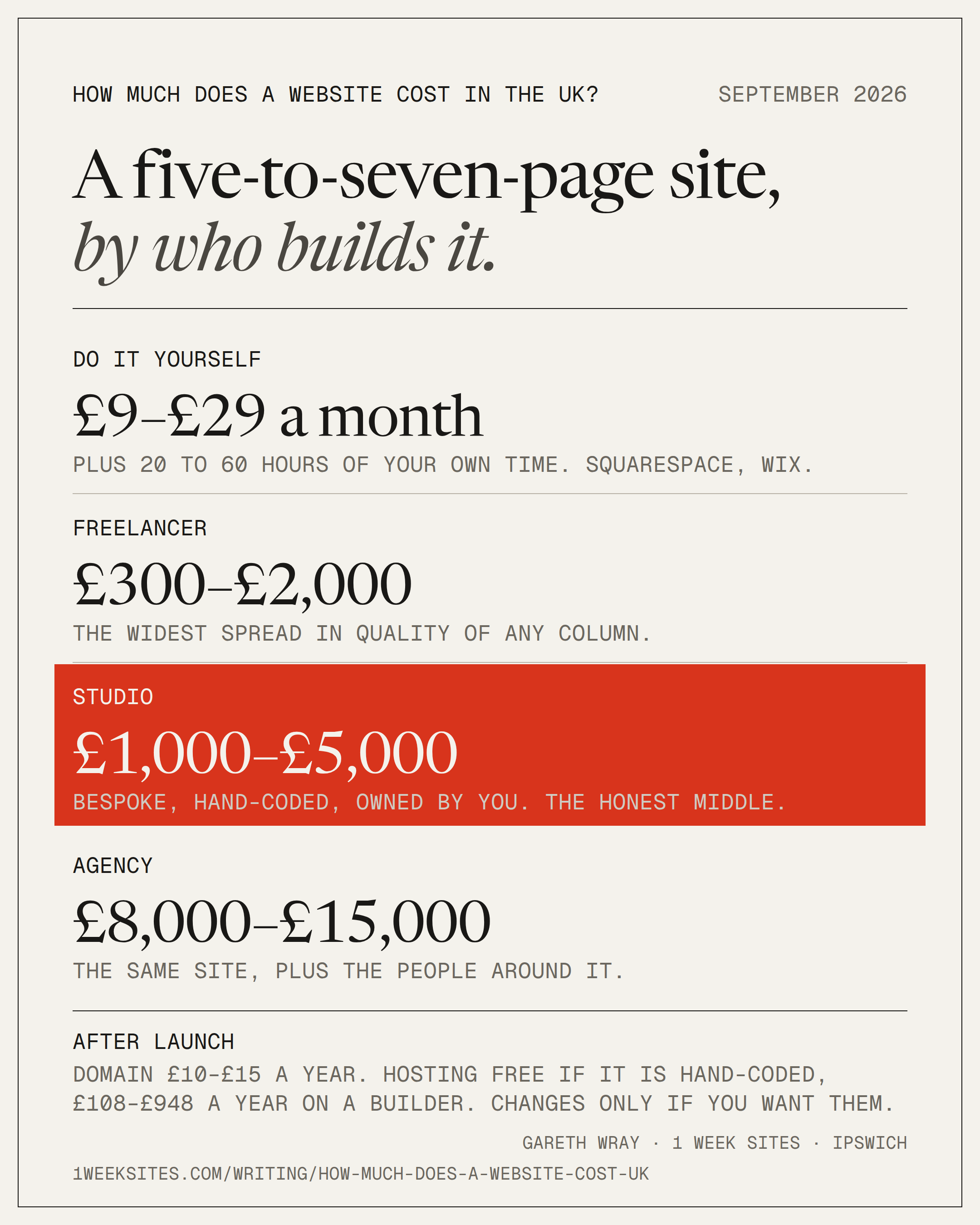
Freelancer, studio or agency: what each costs and what you get
The same seven-page site, three ways of buying it. What the price includes, what it leaves out, and the one question to ask.
What a freelance web designer costs in the UK
£300 to £2,000 for a five-to-seven-page site, £200 to £800 for a landing page, usually a quarter to a half up front. At the bottom of the range the site was made in a page builder or an AI tool in an afternoon by someone who has never had to think about why a visitor buys, and the code those tools ship is heavy enough to hurt the search results. At the top is a specialist with case studies who is worth more than most agencies. Ask to see three live sites and what happened to their enquiries after launch.
What a solo or small studio costs
£1,000 to £5,000 for the same site. One or two people who design and build it themselves, no account layer. Bespoke design, hand-written code, performance and accessibility in scope, and the thinking about what makes someone get in touch. I sit at the bottom of this column at £1,000 because there is one of me and the week is fixed. The studio at £5,000 has two people and more rounds of design.
What a web design agency charges in the UK
£8,000 to £15,000 for the seven-page site, £10,000 to £25,000 once booking, a lead magnet and a CRM are in scope, £15,000 to £50,000 for a larger site or a CMS. Eight to twelve weeks, a deposit of 25 to 50 per cent, and often a retainer afterwards. You are buying a project manager, an account manager, a designer, a developer and a company behind them. That is worth paying for when there are several stakeholders, a brand to build from scratch, or real complexity. For one decision-maker and seven pages it is the £3,500 in the bar chart above.
What you are paying for
Price tracks four things, in descending order of impact.
1. How many people are between you and the work
One person doing it end to end has no overhead. A ten-person agency has at least three people on your invoice who never open the code: a partner, a project manager and a coordinator. On a £10,000 quote, roughly £3,500 pays for meetings. Worth it when the project is complicated. Ceremony for seven pages and one decision-maker.
2. Whether you own it at the end
A site built on Squarespace, Wix or Webflow lives on that platform and you pay for it monthly. Stop paying, or lose the account, and the site is gone; I am rebuilding one right now for a client whose Webflow site disappeared exactly that way. The distinction that matters is whose name is on it. A builder site in someone else's account is rented twice over. A Webflow site in your own workspace, on a plan billed to you, is at least yours to keep, though Webflow always hosts it and the CMS content cannot be exported. A custom-coded site is a folder of files in your name that any competent developer can pick up and move anywhere.
3. Whether anyone thought about what converts
Two sites can look equally polished and one of them gets the enquiry. The difference is the words, the order of the sections, what the first screen asks you to do, why the button is one colour and not another. That thinking is what a £2,000 site has and a £300 site does not.
4. Whether performance and accessibility are in scope
A site that passes Core Web Vitalsand WCAG 2.2 AA takes roughly 15 to 25 per cent longer to build and test. Most cheap quotes quietly drop both, and most page-builder exports fail both, because the tool ships far more code than the page needs.
Three tells: a twelve-week timeline on a seven-page site, a quote with no list of deliverables, and a pitch deck full of people you will never speak to again. Any two of the three and you are paying for ceremony.
Three real projects, with the numbers
Three sites I built, what was asked for, what it cost or would cost, and what happened. Two were priced outside my rate card and I say so.
MN Online Coach: a funnel first, then the site
Mac Nowicki is an online fitness coach in Sheffield. He did not ask for a website. He asked for a landing page for a lead magnet, so he could send people from Instagram somewhere other than his DMs.
- What was built. A giveaway landing page, then aTDEE calculatorwith an email gate, then a protein-guide landing page, and finally the seven-page site to hold it all together.
- What it would cost. The site is one sprint at £1,000 and each lead-magnet page is from £500, so £2,500 for the set at my rate card. Mac is my coach and the work was a service swap, so no invoice changed hands. I quote it as what it would cost, not what he paid.
- What it did. Within a day of Mac posting the calculator to his Instagram, with no ad spend, 30 people had joined his list. The giveaway and calculator went live at the start of 2026, the protein page and the site in August.
The Marketing G: my own site, priced honestly
The Marketing Gis my personal brand and newsletter. The brief to myself was to show a personality and not look like every other site an AI has built this year.
- What was built. A home page, a newsletter with archive, the guides, and a graffiti theme because I like graffiti. Before any design I wrote the source of truth (six rounds of questions, 31 minutes) and built a mood board of reference sites.
- What it would cost. At my rate card the same build starts at £1,000, more for more pages or a design taken further. A fair test of the sprint, because nobody was cutting me a deal.
- What it did. It is the site every client finds before they book a call, and its job is to make the call happen.
Aspire 1 Coaching: £500, from nothing to a working funnel
Mazin Alneami had nothing online when he came to me in 2025: no page, no list, no way to capture a lead. He was one of my first clients.
- What was built. Alanding page with an ebookas the lead magnet, wired into a GoHighLevel CRM, with an automated email sequence behind it.
- What it cost. £500, priced partly to earn the testimonial, which is the honest reason most early-career prices are low. The same job is from £500 on my rate card today.
- What it did. Took the business from no lead capture to a funnel that ran itself. Aspire 1 has since grown into a full gym, so the funnel has probably done its job and retired.
What a website costs per year, over five years
The upfront price is the wrong number to anchor on. Small businesses keep a site three to five years before rebuilding, so run the numbers forward, and count your own time, which is what a builder really costs an owner.
| Approach | Upfront | Each year after | Five-year total | Your time |
|---|---|---|---|---|
| Squarespace Core, DIY | £0 | £204 + domain | £1,070–£1,100 | 20–60 hours to build, then every change |
| Wix Core, DIY | £0 | £192 + domain | £1,010–£1,040 | 20–60 hours to build, then every change |
| Freelancer on a builder | £300–£2,000 | £108–£348 + domain | £900–£3,800 | A brief, then chasing |
| 1 Week Sites, custom build | £1,000 | £10–£15 domain, hosting free | £1,050–£1,075 | A 30-minute call and one week of quick replies |
| 1 Week Sites with £99/mo changes | £1,000 | £1,198–£1,203 | £6,990–£7,015 | An email a month |
| Agency WordPress with retainer | £12,000 | £600–£3,600 | £15,000–£30,000 | Meetings, then more meetings |
By year five the builder has cost the same as the hand-coded site, and you did all the work. The £99 a month is worth it only if you send changes, which is why it is optional.
Website maintenance, hosting and domain costs in the UK
The recurring costs people forget to ask about, with September 2026 UK prices.
| Item | Cost | Notes |
|---|---|---|
| Domain | £10–£15 a year | .co.uk at the cheaper end, .com at the dearer. Paid to your own registrar, in your name. |
| Hosting, custom-coded site | £0 | A static site has no server to pay for. I set it up in your account. |
| Hosting, Webflow | From $15 a month | Basic from $15, Premium from $25 with the CMS, billed yearly, in US dollars plus tax. What a Webflow build from me runs on, paid to Webflow. |
| Hosting, site builder | £108–£948 a year | Wix Light £9/mo to Squarespace Advanced £79/mo, annual billing. Monthly billing adds 16 to 33 per cent. |
| Shop platform | £228–£588 a year | Shopify Basic £19/mo, Grow £49/mo on annual billing, plus transaction fees. |
| Email on your domain | £0, or £71 a year per person | Forwarding from your registrar is free. Google Workspace Business Starter is £5.90/user/mo ex VAT on annual billing. |
| Maintenance | £0, or £99 a month | Nothing to patch on a static site. Changes from me are optional at £99 a month. WordPress upkeep £30–£100/mo. Agency retainers £50–£300/mo. |
| Booking, CRM, analytics | £0 | Cal.com, HubSpot and Google Analytics all have free tiers that a small business rarely outgrows. |
| Content | Your time | The one cost no builder or studio removes. Clients bring the substance; I tighten the wording. |
Estimate your own site
Pick the shape of the site and anything you need bolted on. The ranges are the same ones as the table above, so you can see what each kind of builder would charge and what it would be with me. It also lives on its own page if you want to send it to someone.
One sprint, paid before work starts, full refund if it is not live on the day. Hosting free on a custom build, domain £10 to £15 a year.
E-commerce, a CMS and regulated work: when to spend more than £3,000
A bigger budget is warranted in three cases. The first is a shop. A small one on Shopify is £19 to £49 a month plus transaction fees to run, and £1,500 to £5,000 from a freelancer, £3,000 to £10,000 from a studio or £10,000 to £30,000 from an agency to design and set up. Genuine e-commerce, with many products, stock syncing and VAT at scale, is £5,000 to £15,000 with a good Shopify developer and money well spent. The second is a real CMS that two or more non-technical people will use every week, at £4,000 to £12,000. The third is regulated work, in finance, health or law, where formal accessibility audits and consent flows push the job past £10,000.
For the consultant, the tradesperson, the coach and the two-person firm, none of the three apply. Spending £15,000 on a brochure site is buying ceremony.
How to get a quote that means something
Most quotes are wrong because the brief was one line: “I need a website.” Send this instead and every quote will be comparable.
- What the business does and who buys from it, in two sentences.
- The pages you think you need. Guess. A good builder will correct you.
- What the site must do. Take a booking, capture an email, sell a thing, or just make the phone ring.
- What you already have. Logo, photos, copy, an old site. Say what is missing.
- Two sites you like and one line on why.
- The date you need it and the budget you have in mind. Both, not one.
Then ask two questions of every quote that comes back: is that plus VAT, which adds 20 per cent when the builder is registered, and who owns the domain, the files and the hosting account when it is done. Neither answer is on most quotes and both change the price.
That last line matters. A client I am working with now arrived expecting £300 or £400, because that is what the last person charged, and that site is the one that just died with their account. The conversation is easier with the number on the table. It is how my own week begins: the brief is agreed on Tuesday before any money moves.
The unfashionable conclusion
Price is not correlated with quality once you are above the freelancer floor. A £2,000 site from a good solo studio will beat a £15,000 site from an average agency on every measure a buyer cares about: speed, clarity, whether it converts, whether it is finished. The expensive version buys ceremony, not outcomes.
Under £3,000, find one person with a finished portfolio, a fixed price and a date. £3,000 to £10,000, a small studio with real designers on staff. Above £10,000, make sure the money is buying a shop, a CMS or a brand from scratch, not more layers of management. Comparing against a platform? The comparison pages put me next to Squarespace, Wix, WordPress and Fiverr line by line.
Questions people ask
How much does a website cost in the UK in 2026?
A five-to-seven-page bespoke website for a UK small business costs £1,000 to £5,000 from a solo or small studio, £300 to £2,000 from a freelancer, and £8,000 to £15,000 from an agency. Doing it yourself on Squarespace or Wix costs £9 to £29 a month plus 20 to 60 hours of your time. Prices checked September 2026.
What is the average cost of a website in the UK?
There is no useful average across a market that runs from £9 a month to £50,000. Guides that quote one, usually around £2,000, are averaging a builder plan with an agency invoice. The useful figure is the middle of each column for a five-to-seven-page site: about £1,000 from a freelancer, £2,000 to £3,000 from a studio, £10,000 to £12,000 from an agency. Those are my reading of the quotes clients show me, September 2026, not a survey.
What is a fair price for a professional website in the UK?
For a small business with one decision-maker, £1,000 to £3,000 is fair for a bespoke site of five to seven pages, custom-coded or built properly in Webflow, that passes Core Web Vitals and accessibility checks and sits in your name. Below £500 you are usually buying a template or a builder export with no thought given to what converts. Above £8,000 you are usually paying for people who never touch the work.
How much does a website cost per month in the UK?
A custom-coded site on a static host costs nothing a month: hosting is free, the only recurring cost is the domain at £10 to £15 a year. Site builders charge £9 to £79 a month on annual plans (Wix Light £9, Squarespace Basic £12, Squarespace Advanced £79); Webflow is from $15 a month, billed yearly, in US dollars plus tax, and that is what a Webflow build from me runs on. Shopify starts at £19 a month. Pay-monthly web designers charge £40 to £300 a month, and you usually do not own the site when you stop paying. Optional monthly changes from me are £99 a month. Agency retainers run £50 to £300 a month and often more.
How much does a website cost per year, including maintenance?
Year one is the build plus the domain: from £1,010 with me. Every year after that is £10 to £15 for the domain if the site is custom-coded and static, because there is nothing to patch and no server to pay for. On Squarespace or Wix it is £108 to £948 a year for the plan; on Webflow it is from $15 a month, billed yearly, in US dollars plus tax. WordPress sites need updates and typically cost £30 to £100 a month to look after. Add £71 a year per person for Google Workspace email on your own domain.
How much does a Squarespace or Wix website cost in the UK?
Squarespace UK plans are £12 (Basic), £17 (Core), £29 (Plus) and £79 (Advanced) a month on annual billing, including VAT, and £16 to £24 a month for the lower tiers if you pay monthly. Wix is £9 (Light), £16 (Core), £25 (Business) and £119 (Business Elite) a month on annual billing, 16 to 28 per cent more if you pay monthly. Add 20 to 60 hours of your own time to build it. Prices checked September 2026.
How much does an e-commerce website cost in the UK?
A small shop costs £19 to £49 a month on Shopify plus transaction fees, and £1,500 to £5,000 from a freelancer, £3,000 to £10,000 from a studio or £10,000 to £30,000 from an agency to design and set up. A large catalogue with stock syncing and VAT at scale is £5,000 to £15,000 with a good Shopify developer. I take on shops only when the catalogue is small, and say so on the call.
How much do a domain and hosting cost in the UK?
A .co.uk or .com domain is £10 to £15 a year at any mainstream registrar, in your name. Hosting for a custom-coded static site is free, because there is no server to pay for. On a builder the hosting is inside the monthly plan, £9 to £79 on Squarespace or Wix, from $15 on Webflow. On WordPress you pay a host, and the cheap tiers are usually the slow ones. Email on your own domain is free with forwarding, or £71 a year per person on Google Workspace.
How long does a website take to build in the UK?
A freelancer takes two to six weeks, a small studio four to eight, an agency eight to twelve, and a shop or larger site three to six months. Most of that is waiting: for copy, for photos, for sign-off. I build in seven days, Tuesday to Tuesday, because the brief is agreed and paid for before the week starts and there is one client at a time.
From £1,000. Live in seven days.
One bespoke site, custom-coded or in Webflow, one sprint, paid before work starts, full refund if I miss the day. Hosting free on a custom build, everything in your name.
Free · no obligation · I’ll tell you straight if it isn’t a fit